
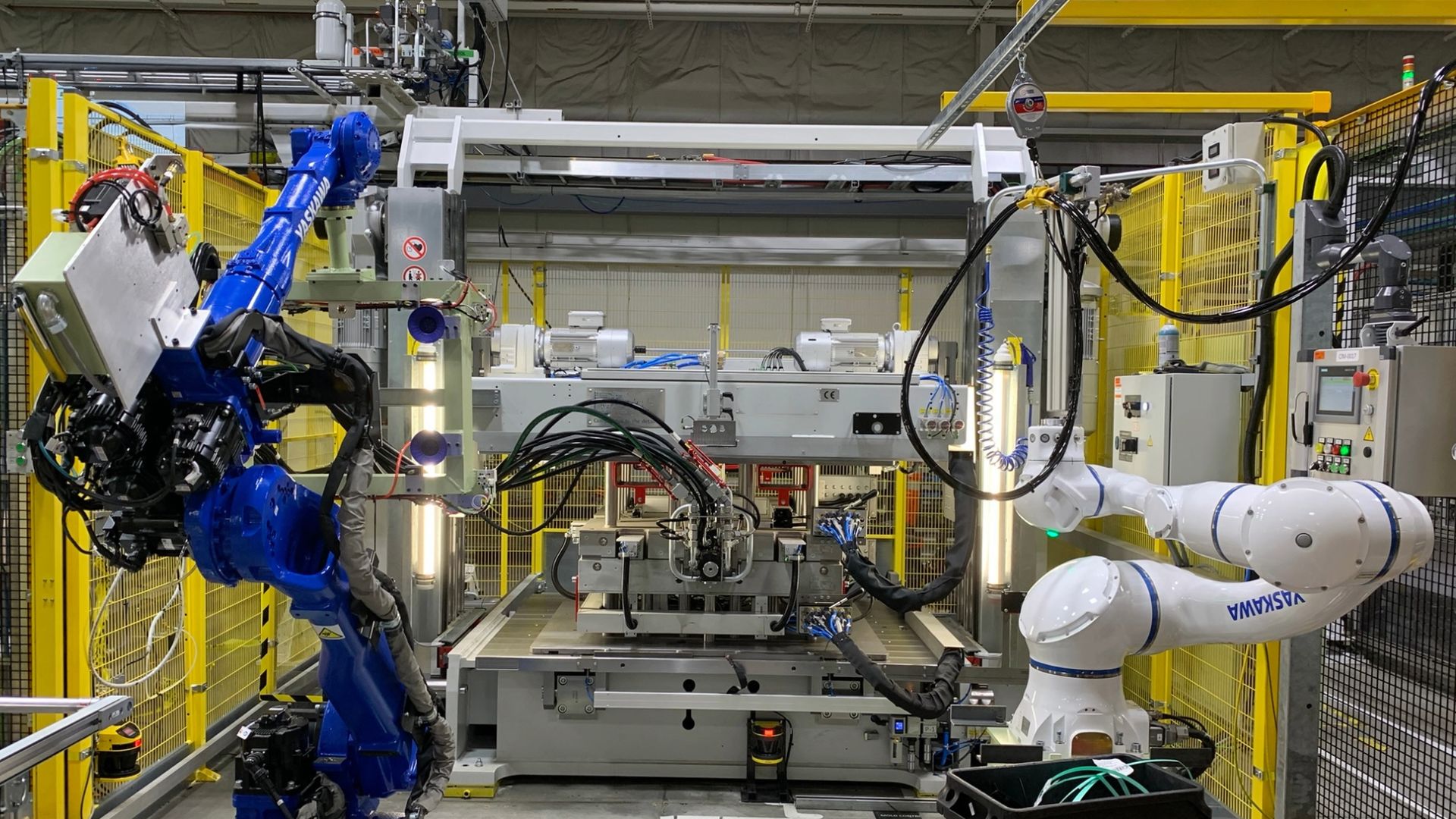
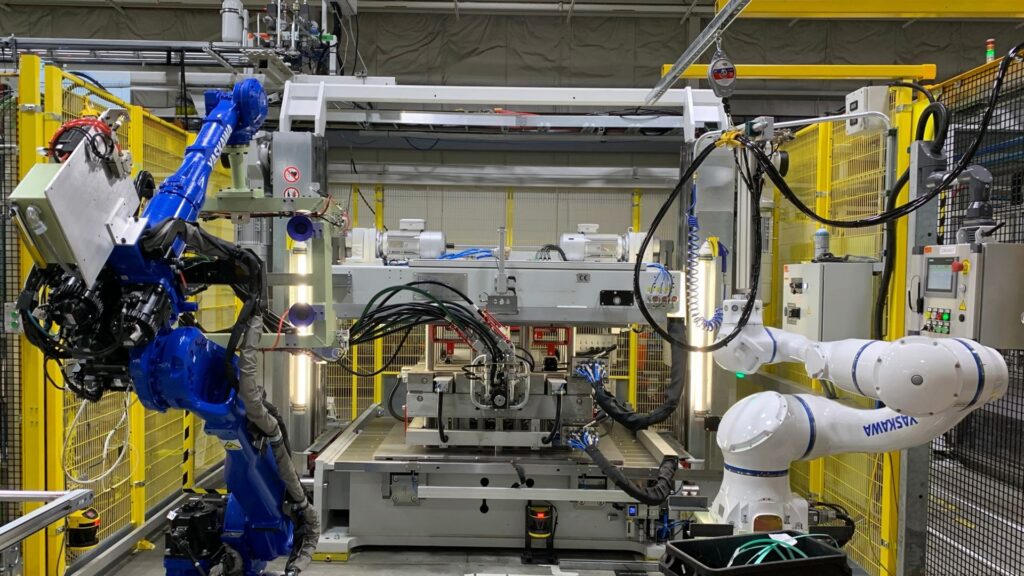
An integrated production cell brings robotics, AI vision and material handling together around a complex molding process.
The situation
A manufacturer was preparing to bring production of a new panoramic automotive sunroof assembly to North America.
The size of the glass made the molding process a natural candidate for automation. Each pane is roughly four feet wide and three feet long. While an operator could handle the glass at an ergonomically positioned conveyor, reaching into a heated mold to load and unload it presented a much greater handling and safety challenge.
Before molding, each pane receives two layers of primer applied manually in a specific pattern. The primer needs time to dry before the glass enters the mold, and the quality of its application can affect the strength of the finished bond.
The customer needed a production cell that could safely handle the large glass while maintaining the timing, quality and process controls required to produce the finished assembly.
The opportunity
Each pane had to be loaded in the correct orientation, inspected for primer quality and tracked through a defined drying window before molding. Between cycles, the mold needed to be cleared of debris and prepared for the next part.
Those requirements called for different types of automation working together, while still leaving some tasks with operators where manual handling made more sense. The cell also needed to accommodate two different glass geometries and maintain the part tracking and process data required throughout production.
The approach
Black Controls designed the cell around the requirements of each step in the process, integrating a conveyor and tracking system, AI vision, an industrial robot and a collaborative robot through a coordinated control system.
The press and molds were supplied by another manufacturer, with Black Controls’ control system interfacing with the press to coordinate the loading, unloading and cleaning cycles.
At the start of the process, an operator applies primer to the glass and loads in on the infeed conveyor. As the glass moves down the conveyor, it stops at an inspection station where an AI vision system evaluates whether the primer application falls within acceptable parameters. Images captured during inspection are stored for quality assurance purposes.
The conveyor was designed to provide enough travel time for the primer to meet its minimum drying requirement, which the system verifies before the glass proceeds to the press.
At the press, an industrial robot picks up the unmolded glass from the conveyor, loads it into the heated mold, and moves the finished assembly to the outfeed conveyor. Between press cycles, a collaborative robot cleans the mold and applies mold-release agent. The lighter frame components continue to be loaded manually by an operator.
Black Controls designed, simulated, built, programmed and tested the complete cell, including its mechanical and electrical systems, before installation. The design had to accommodate two different glass geometries, and the vision inspection was added after the original layout had been established. Black Controls adapted the system as the process evolved and continued to refine it through commissioning.
The outcome
The integrated cell is now in operation at the customer’s facility as production ramps toward full volume.
The AI vision application continues to be refined as more production parts provide new examples and edge cases. Black Controls continues to support the customer through ramp-up, adjusting as the process moves toward full production.
Not sure how to automate a complex production process?
Talk to Black Controls about what’s possible.